
thoughts on recent films
"wuthering heights," a secret agent, marty supreme, etc.

Well, friends, it’s about that time. Between December and March, anyone who calls or texts me will likely receive only silence in return, followed some hours later by my most frequently texted sequence of words: Sorry! I was at the movies.
God, just typing that gave me goosebumps. What will I see next?
It’s not that I place too high a value on awards1 or particularly trust these organizations’ nominating skills and/or procedures2, but I do care—a lot—about one thing, and that is being an informed hater. I loooove a well-founded opinion strongly held by me. It’s like oh, who is she? Her, with the perpetually furrowed brow and frequently flawless hair? Just a girl who knows what she’s talking about because she did her homework.
A reminder, I guess, that I’m on Letterboxd. I try to do the pithy review thing, but sometimes it mostly ends up being a brief diary entry, more than anything.
Below I discuss The Secret Agent, The President’s Cake, “Wuthering Heights,” Hamnet, Marty Supreme, and Sorry, Baby. There are maybe some light spoilers involved, if you care about that sort of thing. I usually don’t.
The Secret Agent (2025) (dir. Kleber Mendonça Filho)
Outside of film circles and the Letterboxd Community™, I haven’t seen too much about this Wagner Moura vehicle, so I’m putting this at the very top of this list because I do not want you to miss it. Do you know how good this film was? If you don’t, it’s because you haven’t seen it yet, and if you haven’t seen it yet, literally what are you waiting for?! I mean, obviously I just recently saw it (was waiting for the theater release), but I happen to be very good at throwing stones from my personal glass house. Are you as good? Do you wanna take that risk?
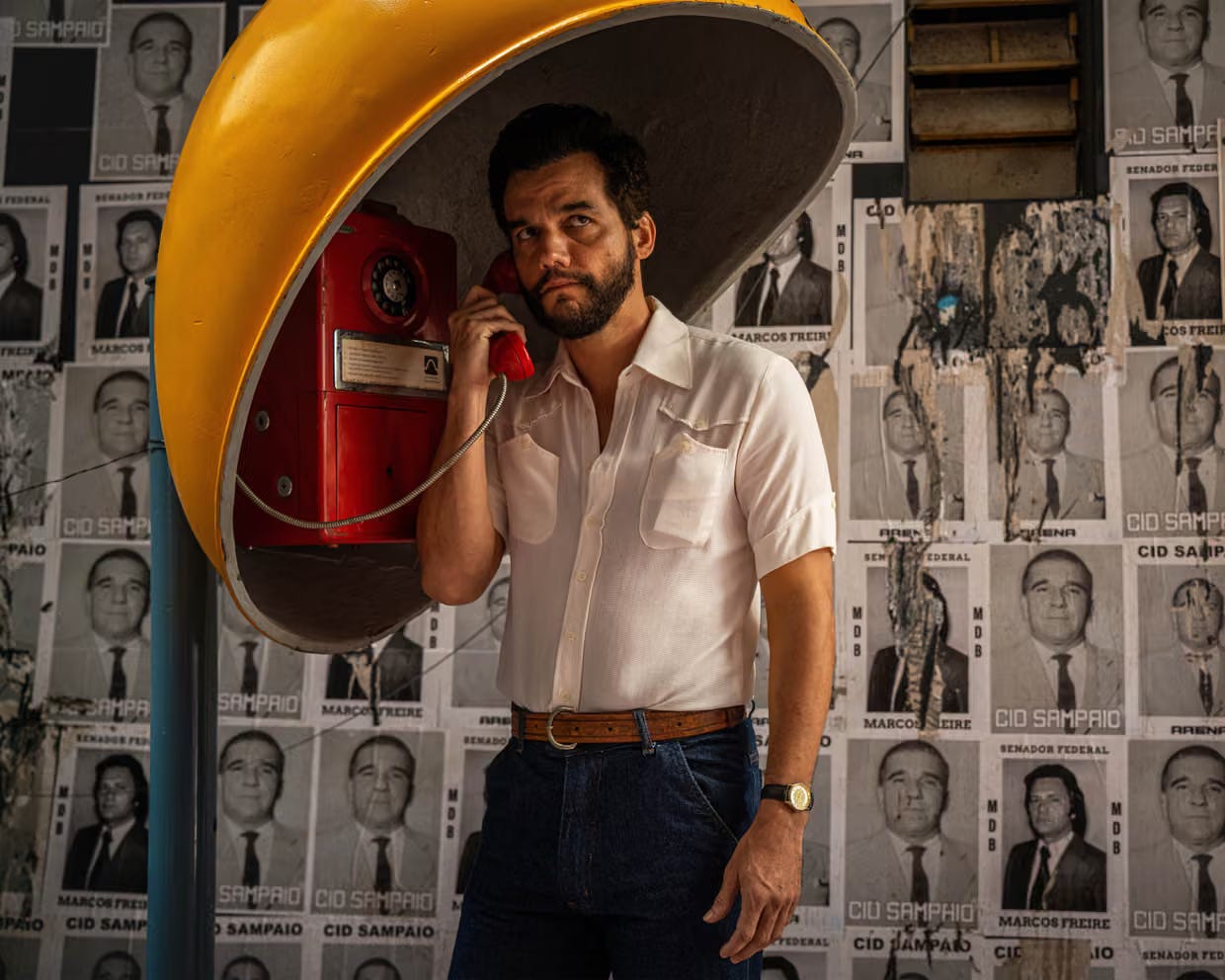
The Secret Agent tells the story of Wagner Moura’s Marcelo (né Armando) as he drives his (charming!!) yellow beetle (seriously, why don’t I have a yellow beetle?) to Recife, the northeastern city of his birth, to seek temporary refuge from threatening forces only vaguely alluded to until dawning in terrifying clarity on the film’s last hour.3 Especially towards the beginning of the film, it feels as though we’ve intruded into Marcelo’s life, catching him at an inconvenient time as he negotiates the crisis in which he’s unwittingly found himself. If it takes us a while to understand the source of his troubles, it’s because he’s still figuring it out himself.
It takes some time—not very long—to understand that we’ve met Marcelo at a very Hiding From Fascists Time In His Life. It is 1977 when the film starts, a little beyond the halfway point of Brazil’s military dictatorship (1964-1985). But of course you don’t know how much longer you’ve got to withstand when you’re going through it, do you? The boulder in front of you is all you see. Not to quote Joan Didion, but there comes a point when [surviving] every day is all there is.
This was an outstanding film, connecting past and present in a way that never feels forced, and showcasing supporting roles better than a lot of much-lauded performances I’ve seen this year (Dona Sebastiana and Fernandinho, the sky is literally yours!). And the following may not be a particularly sexy thing to say, but at 160 minutes, The Secret Agent was the best paced film I’ve seen in the last year. And yes, I’m including One Battle After Another in that ranking.
On the heels of last year’s I’m Still Here, we’re witnessing a really exciting moment in Brazilian cinema. Fueled by generational trauma and the annals of twentieth century Latin American history, sure, but art flows from the darndest pockets of darkness, doesn’t it?4
The President’s Cake (2025) (dir. Hasan Hadi)
I’ve written about my love of/for solo cinema dates a few times, most recently in November, when I said:
[T]he lure of a foreign film will always get me to leave my house. There’s just something about subtitles, I fear.5
This film wasn’t on my radar until I saw it on my cinema’s homepage, the image of a uniform-clad young girl sitting on a stone ledge, staring despondently into the distance while—inexplicably, tenderly—holding onto a rooster. A rooster!
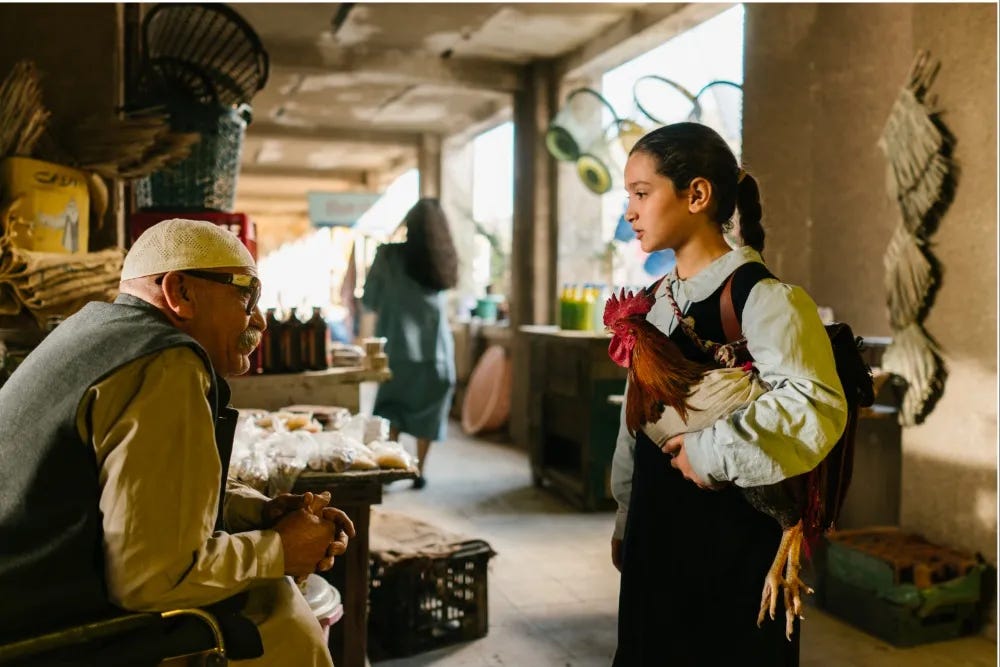
Forgive my ignorance, but I had no clue that during Saddam Hussein’s dictatorship, the government selected children from schools to bake the erstwhile president6 a cake for his birthday. And while as a euphemism enthusiast I did say selected, it does appear that the word best suited for the task may instead be conscripted. Set in 1990, a time when UN-imposed sanctions have already begun to deeply impact Iraqis’ access to the basket of goods, acquiring the materials and ingredients to bake said cake was a mission in itself.
And it is this mission that the film takes us on: Lamia, the schoolgirl tasked with the baking of Saddam’s cake, goes on a heroine’s quest alongside the requisite side characters that include the aforementioned rooster (Hindi is his name btw and do not forget!), her best friend and neighbor Saeed, her grandmother Bibi, and a gregarious, frequently life-saving driver.7 There are bureaucratic nightmares to contend with, yes, and petty abuse of small positions of power, along with a particularly nefarious character, but for the most part we are led to believe—maybe to hope—that Lamia will make it, whether by the grace of God, her own determination, or the kindness of strangers.
The President’s Cake was Iraq’s first Cannes entry, and my god, what a debut. Like Jafar Panahi choosing to shoot It Was Just an Accident (2025) in Iran despite the logistical, technical, and political obstacles, director Hasan Hadi insisted on shooting the film in Iraq, to illustrate the real country as opposed to a mere facsimile on a soundstage.
That was a crucial aspect for me. We had lots of offers of [sic] people saying: “Hey, we will fully fund this film, but we need to shoot this film outside Iraq.” And I was like: “Absolutely not.” And one of the reasons I wanted to shoot in Iraq is to show Iraq …. And I don’t think people will expect that Iraq looks like this, or has these kind[s] of visuals. But of course it was very challenging. (Variety)
This wasn’t a film light on casual tragedy and devastation by any means; I found myself deeply touched by the story. Hadi observes his characters and the country of his birth keenly, respectfully, and lovingly. You can’t help but emulate his perspective.
“Wuthering Heights” (2026) (dir. Emerald Fennell)
I don’t think I’ve gone into a screening with lower expectations since my eyes and ears were accosted by Emilia Perez back in December 2024. We all remember where we were, I assume, when that trainwreck took over. “Wuthering Heights” did not, to be clear, sink to EP’s subterranean levels. An impossible feat, after all.
To get this out of the way: Margot Robbie is too old to play Cathy, Jacob Elordi is too white to play Heathcliff, and they are both too spiritually and literally Australian (see: you can tell their vowels sound a little fucked and you could see them effortlessly excelling at most athletic endeavors) to play two morose and depressed people who grew up in the grey Yorkshire moors. Barring Alison Oliver’s turn as Isabella and Martin Clunes’s stomach-churning portrayal (complimentary) of Mr. Earnshaw, I can’t think of a single role that was well-cast.
Further, a couple of personal caveats: I am a fan of the Emily Brontë novel that inspired this film8 and I have not enjoyed the bit of Emerald Fennell’s past work I’ve willingly exposed myself to.9
With that, then.
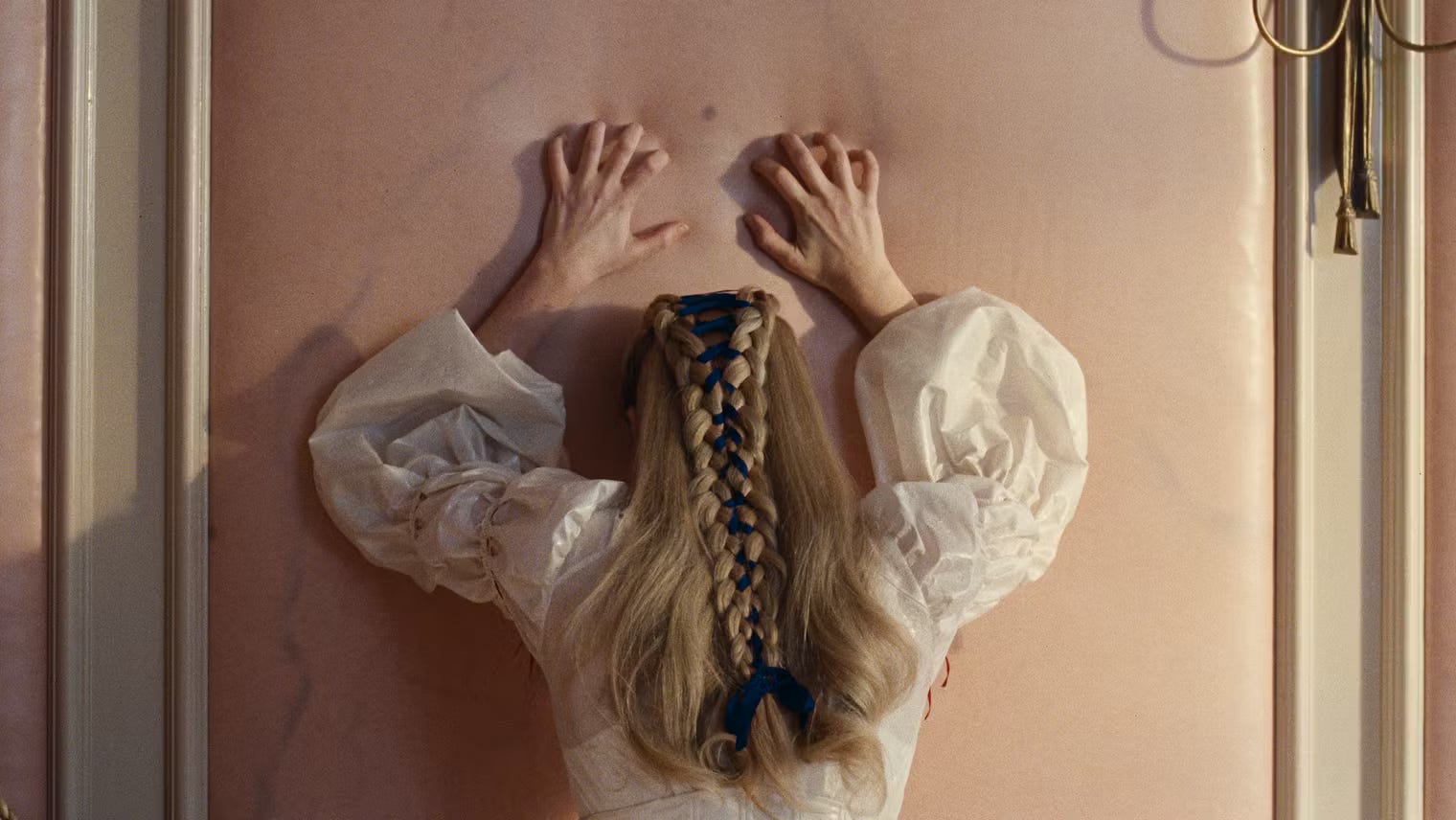
This was not a “good” “film,” to use the punctuation Fennell decided to employ when she titled the film not Wuthering Heights but “Wuthering Heights” like she’s a younger sibling with her hands half an inch from your face taunting I’m not touching youuu. I miss when people didn’t eschew maturity in favor of so-called whimsy. I’m tired of whimsy.
The director claims the title affectation is due to this being an adaptation based upon the feeling(s) she had when first reading the novel as a teenager.
All of the adaptations that have come before it are amazing. That’s absolutely why the title is in inverted commas. I’m aware of how personal the book is to so many of us, so I wanted to communicate as early as possible that it could only ever be an attempt to take a tiny piece of the book and make sense of it.
….
The starting point [of this adaptation] is imagining you’re a young girl who doesn’t really know what the Victorian or Georgian eras look like. We asked: if we were aliens given this text, how would we recreate this world? (W Magazine)
… Sure. Like, I’m sorry, but I lay the blame for all this in large part at the feet of tiktok therapists. This is what happens when we indulge every one of those “honor your inner child” videos instead of shaming people into growing up at least a little bit. Stop honoring, start de-arresting your emotional development. Jesus.
Keep reading with a 7-day free trial
Subscribe to Hmm That's Interesting to keep reading this post and get 7 days of free access to the full post archives.