
we can let emily wilson be a little mean, as a treat
on [reviewing] the odyssey

I kinda wish I could find it within myself to care about the fact that Emily Wilson, the most famous (?) of Homer’s living translators, didn’t much appreciate Christopher Nolan’s The Odyssey (2026). For the London Review of Books, in 4,234 words, she (hilariously, pettily) called the film “an entertaining way to hide from the high temperatures for a few hours.”
She also said, in what’s probably been the most shared line from the review, that:
I would be ashamed to have written any part of this script.
People have been displeased with the contents of Wilson’s critique, but more than that, with her tone, calling it overly scathing. Arrogant. Mean, even. A classicist, wielding vast knowledge of dead languages most of us scoff at, arrogant? Surely not! It’s like no one actually read The Secret History, despite its inclusion in every single booktok over the last five years. What did you guys think dark academia meant?
So Emily Wilson, a person who’s dedicated her entire professional life to understanding and teaching and translating classical works, did not enjoy an adaptation of one of these works by one of the most popular (and commercial, which is not intended as a diss, but as a relevant data point!) filmmakers of our time. Please, for the love of Zeus, sound the alarm!!!
(Is this the most clicks an LRB review has ever received, btw? Someone with the intel, please feel free to email me—your anonymity will be protected, I’m just nosy.)
I personally liked The Odyssey just fine. It wasn’t my favorite of Nolan’s, because Interstellar and The Dark Knight exist, but I enjoyed the film. Will probably need to watch it again in the relatively near future, given I was still suffering the effects of World Cup-related exhaustion when I saw it a couple weeks ago and as such was keenly aware of each and every one of the film’s 173 minutes. Just an honest little disclosure, from me to you, in the interest of transparency.
Unlike Emily Wilson, though, I am not one of the leading experts on Homer. I’d be soooo much more annoying if I were, but with apologies to my old Classics professors, I can’t say I’ve ever given much thought to the man or his oeuvre. Now, if you wanted me to opine on Jane Austen adaptations …
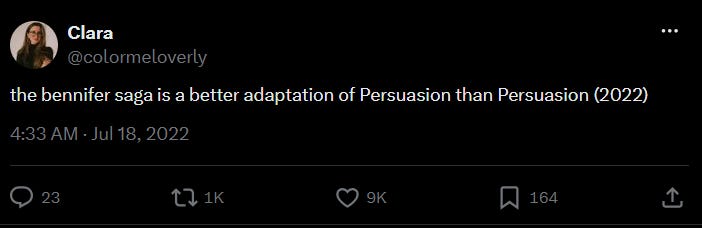
… Well, that’s a different story, isn’t it?
*
I am not an unkind person, but I do find myself quite vexed by the insistence on niceness when it comes to criticism. Not intelligent, not knowledgeable, not even entertaining, but: was the reviewer nice?
So many comments about Wilson’s review have boiled down to her perceived tone. Folks are fretting and wringing their hands at a scholar’s apparent haughtiness. Is it possible that in her review, Emily Wilson hurt Christopher Nolan’s feelings? Shouldn’t she have been gentler? I feel insane. Who cares!
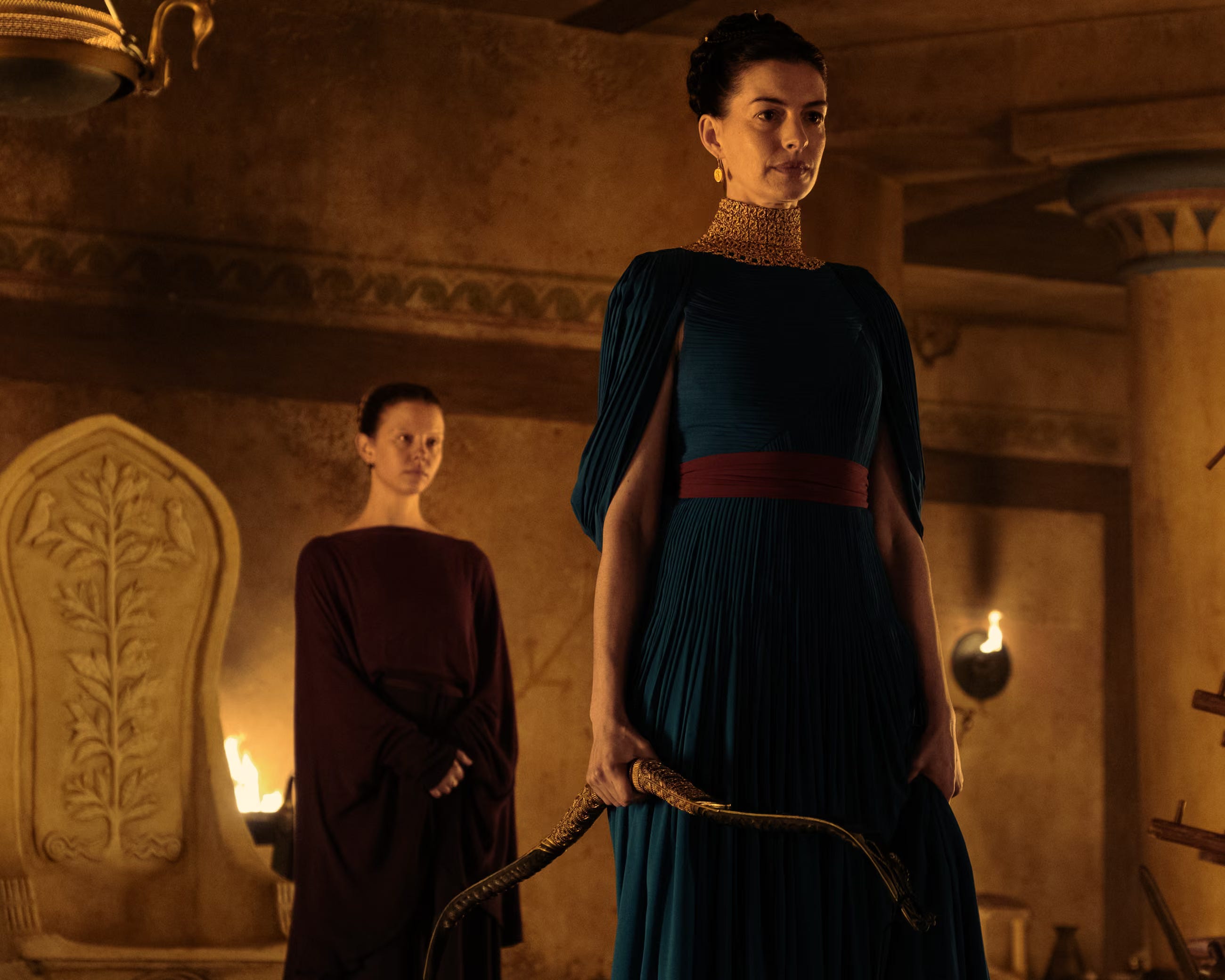
In her review, Wilson is funny;
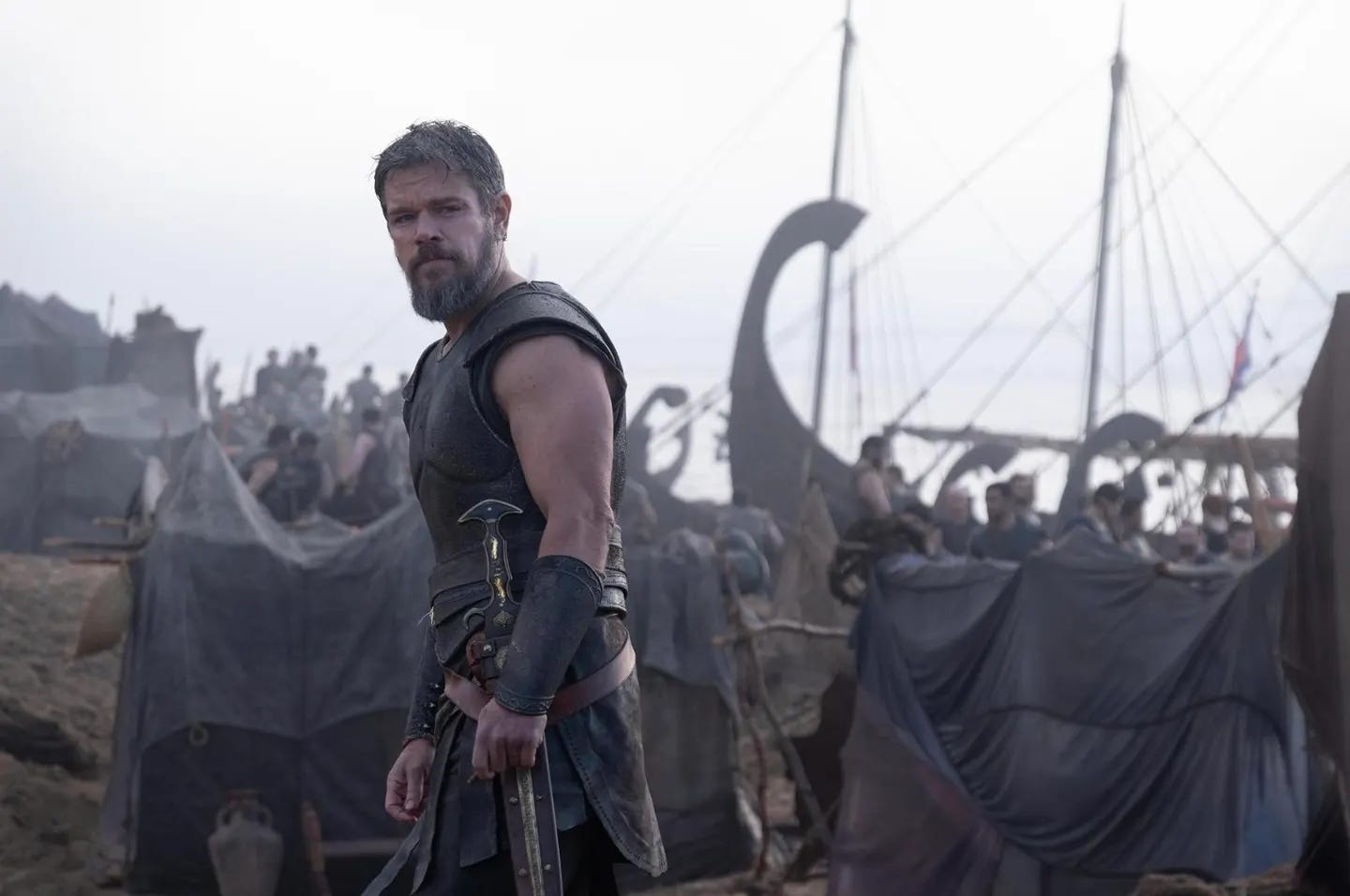
Perhaps more surprising from the director of Oppenheimer, Damon’s lummoxy Odysseus also seems to lack technological intelligence (polymēchania). He does not build a marriage bed out of a tree growing in his house (it would be a waste of effort, since he so rarely seems to sleep or have sex). (Emphasis mine.)
—she acknowledges the role (and the need) of new perspectives in adaptations;
Adaptations needn’t and shouldn’t follow the original with anything like the exactitude of a translation. Some of the best radically transform or resist the source material, providing what Harold Bloom called ‘strong misreadings’ of their ancestors. The most memorable creative responses to The Odyssey – such as Euripides’ Helen, Virgil’s Aeneid, Milton’s Paradise Lost, Joyce’s Ulysses, Walcott’s Omeros, Atwood’s Penelopiad, Madeline Miller’s Circe or Lisa Peterson’s play set in a modern migrant camp – reconsider the poem’s structure, narrative and values.
—she makes clear her deep appreciation for (and bias toward) the world Homer created;
One of Odysseus’ funniest (and most famous) tricks in Homer is to tell Polyphemus that his name is ‘No Man’. When the blinded giant screams for help from his neighbours, the other Cyclopes are reassured to learn that ‘No Man’ is hurting him. In the movie Odysseus doesn’t have to outwit Polyphemus because the Cyclops is a puppet who has no wits.
—how, indeed because of this deep appreciation, she was disappointed by the film’s interpretation of the source material;
Homer’s Penelope gives the disguised Odysseus a wonderfully vivid account of a dream she has had about some geese in her yard being killed by an eagle; the eagle explained that the geese were her suitors, soon to be slaughtered by her returning husband. But in the dream, Penelope wept – suggesting a fascinatingly ambivalent response to the return of Odysseus and the imminent end to her long period of waiting, like a bride, for a husband. Nolan’s Penelope has no dreams. (Emphasis mine.)
—she correctly praises Robert Pattinson’s performance (the best of the film, along with Samantha Morton’s and John Leguizamo’s? Maybe!);
The exuberantly villainous Antinous – Pattinson is the only person on set who seems to be having any fun – clearly deserves to be stabbed to death with the dagger of Sinon, but he also deserves one of the Oscars that will shower down on this movie like the golden rain of Zeus.
—takes a swing at some of the unfair criticism directed at Nolan;
Despite the manufactured online outrage, there is nothing inherently wrong with the movie’s attempt to approximate contemporary American speech. If you’re not going to compose a script in Homeric Greek, or even in metrical English verse, you might as well use something like conversational American English.
—and yeah, at times she’s ever-so-slightly cutting.
Charlize Theron’s Calypso looks gorgeous, but she is never angry, never funny, not skilled in rhetoric, and never consumed by lust for her scraggly mortal victim. She’s an unpaid therapist, soothing the soul of the bedraggled, PTSD-ridden Odysseus with drugs, and graciously listening to his disjointed tale of woe.
I enjoyed the review enormously, even if I don’t agree with every point Wilson makes. It’s a piece written from the unique perspective of one of the foremost Classics scholars alive today, and I read it in a manner befitting that point of view. Because why wouldn’t I?
Why are so many people acting as though Wilson bought out a full-page ad in the Times to shout obscenities at some unknown filmmaker? Like, I know Nolan has shooters because I’m occasionally one of them, but a translator of Homer’s works laying out her reasons why she didn’t enjoy his adaptation of The Odyssey does not seem like a good enough motive to bring out our pitchforks. So she was, at times, a bit snarky. And??? Have you never cared so much—known so much—felt so much—about a subject only to see it misunderstood on a very large scale? I’d have written 4,234 words about that Netflix adaptation of Persuasion, and I’d have been much meaner than Emily Wilson.
What is the point of asking an expert to review a work of art if we expect their expertise to play second fiddle to their politesse? How boring! There is a very weird expectation of humility when it comes to criticism that does not sit well with my spirit. When was it decided that one needed to be diplomatic and tepid when delivering well-articulated and deeply-researched reviews, pieces that by their very nature are understood to invoke someone’s opinion?
Gentle prevaricating often serves to dilute meaning. It’s fine—better, even—to write definitively about subjects you know more than most people about. How tiresome, to always hedge one’s bets to ensure no one’s offended. Because is the purpose of criticism cordiality, or is it to put a critic’s knowledge to work so that we, the audience, might deepen our understanding of the matter at hand? Do we read to learn or merely to reaffirm our pre-existing opinions? Is new information—are new points of view—allowed to creep in? I mean, my god. Again with the declining literacy rates.
Informed and unwavering points of view are not inherently mean. Maybe we’re just not used to them anymore.
*
This didn’t fit in anywhere else, but the most underrated part of Wilson’s review to me was her praise of The Return (2024), another adaptation of The Odyssey, this one more limited in scope and starring Ralph Fiennes and Juliette Binoche as Odysseus and Penelope. I was, I think, one of seven people in the audience when I watched The Return in theaters, and I found it a bit of a mess.
Thanks for reading! You can find me on instagram. The newsletter is fully supported by readers, so if you often find yourself thinking I enjoyed that and also I happen to have disposable income, please consider sharing the newsletter with a friend and/or becoming a paid subscriber for $6/month or $40/year.
"What is the point of asking an expert to review a work of art if we expect their expertise to play second fiddle to their politesse? How boring! There is a very weird expectation of humility when it comes to criticism that does not sit well with my spirit. When was it decided that one needed to be diplomatic and tepid when delivering well-articulated and deeply-researched reviews, pieces that by their very nature are understood to invoke someone’s opinion?" YESSSSSSSSSSSS exactly! Why is every person on the internet allowed to have their take on every single thing but god forbid an educated woman says how she feels with her whole chest? It's HER opinion!
I feel like, after Nolan mentioned in an interview that he read Emily Wilson’s translation of the Odyssey, some people were (maybe unconsciously) expecting her to be grateful to him for „promoting” her work - probably not realizing that she is well regarded in her field and doesn’t seem to aspire to become a celebrity. so now, they are surprised that she dared say anything negative about the movie, I don’t think that element of surprise would be there if Nolan didn’t specifically mention *her translation*