
i am begging you to read this steinbeck novel
no, not grapes of wrath or east of eden

First of all, thank God for used bookstores managed by ornery employees who hate people but love literature. Who would I be without them to impress? Do you know how many obscure1 titles by well-known authors I’ve found stacked in the dark shelves of dusty—and fine, yes, musty—second-hand bookshops?
I can’t really shut up about good things happening to me, so upon discovering a new-to-me standout, I go full Paul Revere about it. I’ll finish a book that changed my life and inevitably, I’ll spend months trying to convince everyone who’s ever shown even the slightest literary inclination to read the book in question. Do you want to borrow this, I text, in increasingly frantic tones. My rate of success on these operations varies.
Which is to say, I’ve already gone through this exercise with my irl friends. So I’m now expanding my zone of potential persuasion. My virtual do you want to borrow this, if you will. The email version of me carrying a book I love in my bag, just in case I run into someone who might be interested. Picture me, then, sleep-deprived and high on caffeine, slamming a thin, brittle, slightly yellowing tome in front of you and, in the tone of a scammy Instagram ad, asking have you tried this 1957 novel no one but me has read in approximately 60 years?
I’m gonna go ahead and assume the hypothetical answer to my hypothetical question is no.
So it’s my duty, really, to introduce (in a spoiler-free capacity, I promise) the concept of John Steinbeck’s hilarious novel(la) The Short Reign of Pippin IV.2
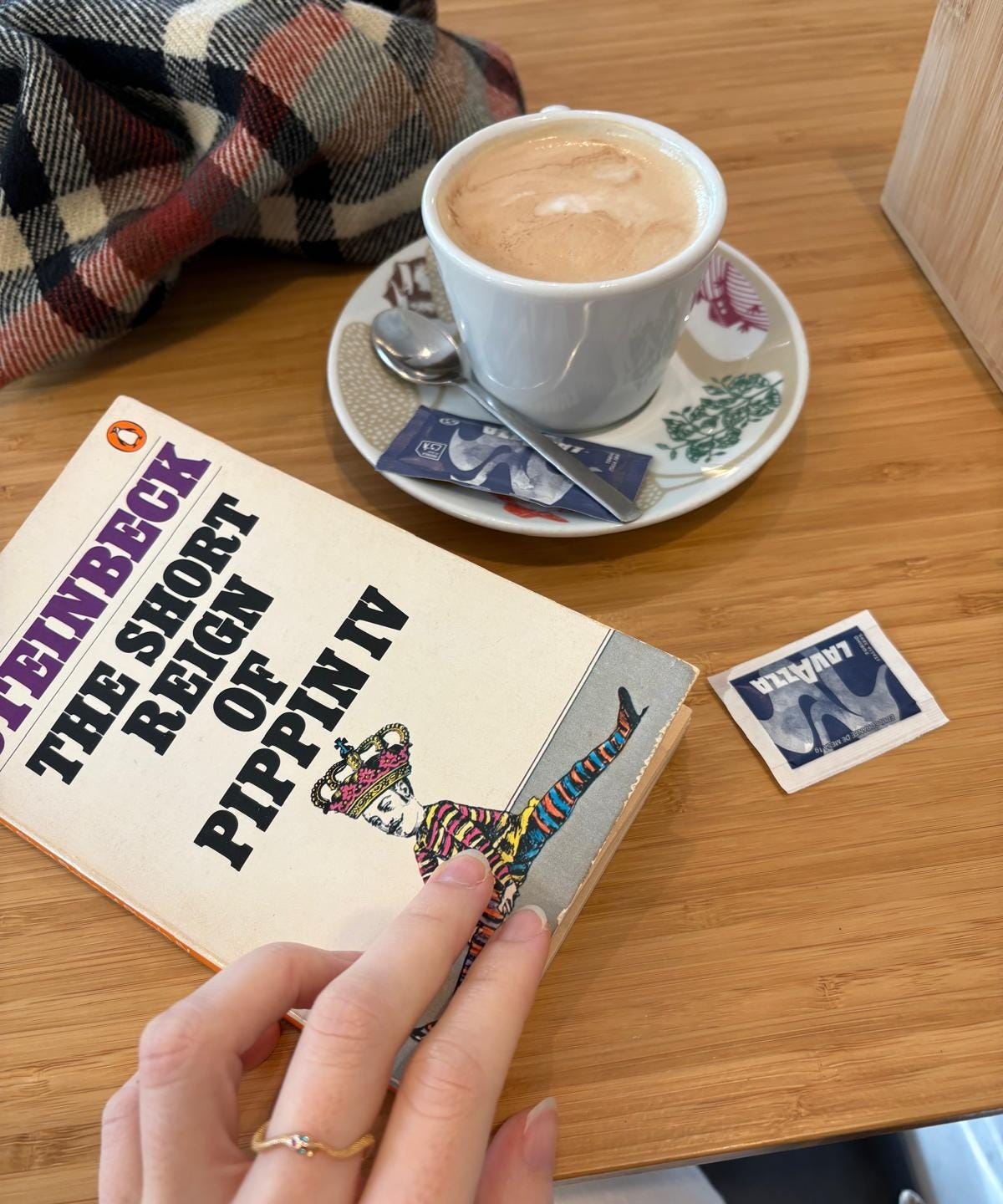
This is where I announce you should stop what you’re doing literally right now—oh, you’re in a meeting? grow up, everyone currently drawing breath is in a meeting! we exist in a neverending zoom call and life is the tabs we keep open in the meantime!—and order the book.3 No, you will not find it in the bookstore unless you, too, are the luckiest person alive and find it at your local used bookshop.4
Listen, I know everyone is rushing to read East of Eden before the Netflix (?) adaptation (a series?) comes out, but take this, my subtle plea, as a sign from above: read The Short Reign of Pippin IV, too. Not instead, mind you, and not even first, because Eden is very much worth reading. It’s a brilliant and unnerving tale and deserves your attention. Like, Tolstoy walked so Steinbeck could run, and I mean that. Eden—along with Grapes of Wrath, which I just finished a couple weeks ago because I wanted to be able to say that I’d read both of Johnny’s magnum opera5—is Serious Literature™. It’s genius. It will enrich your inner life and reward your literary efforts with a surge of righteous self-congratulations.
While reading Eden and Grapes will make you feel accomplished, Pippin will make you laugh. And I’m not even talking about the stuffy, academic sort of laugh that follows wry jokes about, god, I don’t know, Hegel or Saint Augustine or Keynesian economics.6
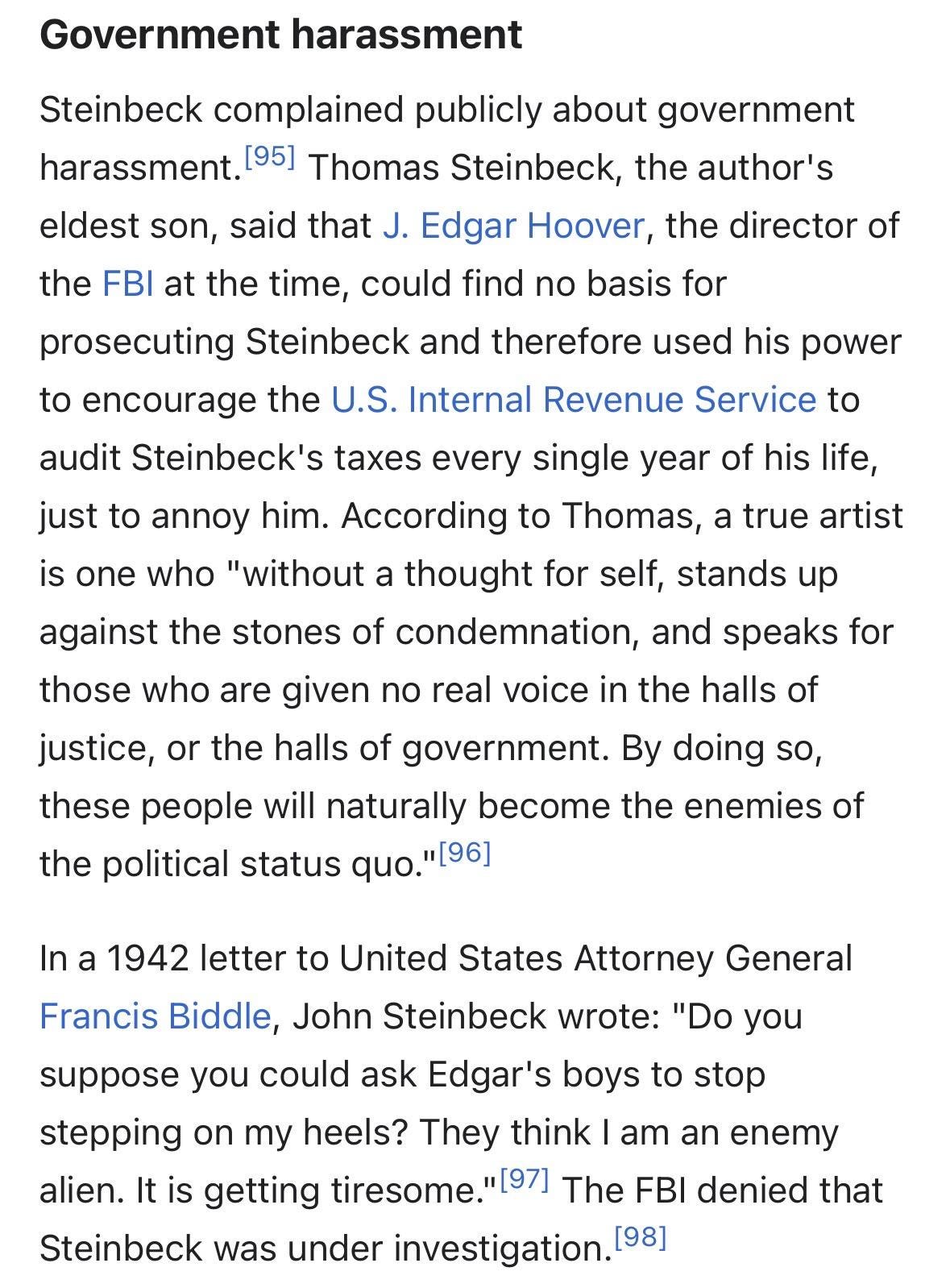
This is the novel written by an author who, after publishing at least two critically-acclaimed Great American Novels, winning the Pulitzer and the Nobel, serving as a war correspondent, and being casually harassed by J. Edgar Hoover,7 no longer has anything to prove, and has decided to shoot the breeze by waxing poetic about French ineptitude. Who among us can say to be free from such creative urges?
***
I realize that it’s been about 700 words and I still haven’t told you what the novel’s about, so here, if we must: The life of an amateur astronomer named Pippin Héristal is turned upside down when he is surprisingly—and entirely against his will—crowned King of France by a varied and desperate coalition of political parties. For approximately 150 pages, hijinks and shenanigans of the most drôle nature ensue as the new sovereign and those nearest and dearest to him react to his new role.
Reading Pippin, you’ll think oh, Steinbeck was funny funny. Which you will already know if you’ve read Cannery Row, which has lines like:
While he was looking for a question Doc asked one. Hazel hated that, it meant casting about in his mind for an answer and casting about in Hazel’s mind was like wandering alone in a deserted museum. (30)8
Hell, even Grapes of Wrath, i.e. the Communist Manifesto Pt. 2, has its haha moments, what with:
Jesus Christ, one person with their mind made up can shove a lot of folks aroun’! (198)
But, goddamn it, Al, don’ keep ya guard up when nobody ain’t sparrin’ with ya. (213)
“A fella got to eat,” he began; and then, belligerently, “A fella got a right to eat.”
“What fella?” Ma asked. (443)9
My copies of Eden and Of Mice and Men are across the Atlantic, but I’m sure I laughed at some point reading those, too.
A sort of gallows humor, though, the one in Steinbeck’s earlier novels. The kind that could be described as providing comic relief to occasionally lift a reader out of the terminal [D][d]epression illustrated in and created by his stories. A functional sort of humor, the kind that comes necessarily attached to a moral lesson, which is why the laughs are in the vein of strained, reluctant chuckles rather than full, honest guffaws.
Because yes, Steinbeck’s satire in Pippin is indeed clever, but you don’t have to suffer through death and poverty to get to it. He’s not overly smug about the cleverness, either. I don’t want to call the style of Pippin fluffy, what with the term’s derogatory implications, but it is light. One can imagine Johnny giggling over his typewriter as he penned lines like:
M. Flosse suggested that the king’s first official act should be to request a subsidy for his government from America for the purpose of making France strong against Communism, and an equal subsidy from the Communist nations in the interests of world peace. (41)10
Almost needless, given the above, to tell you Pippin was published smack dab in the middle of the Cold War. Naturally. And like all of us who’ve seen The Death of Stalin (2017) know, the Cold War is a veritable fount of satirical material. Add to that the honorable tradition of Americans fondly (mustn’t forget Lafayette and Lady Liberty) mocking the French and, well. We’ve a chaotic little masterpiece on our hands.11
***
It’s not necessary, but maybe it helps to have a teensy bit of background on French history to fully appreciate Pippin. A teensy bit. Mostly just mostly knowing that (1) when it comes to French government, chaos and uncertainty have traditionally reigned, and (2) the Fourth Republic, boasting a series of 21 administrations over its 12-year duration from 1946 to 1958,12 was particularly susceptible to dysfunction.
The Fourth Republic, to get ever-so-slightly in the weeds, failed for a variety of reasons internal (power was too decentralized between the political parties to allow for much effective governance) and external (in 1954, war broke out in soon-to-be-former French colony Algeria, eventually prompting the French Army to issue a charming little ultimatum demanding that a new government be created under De Gaulle or else they’d revolt). What really characterized this long decade of French governance, though, was disorder and fruitless dissent. A sort of country-wide extended Thanksgiving dinner.
In Pippin, Steinbeck takes that very real chaos as his point of fictional (and satirical) departure—
It was and is no new thing for a French government to fall for a lack of a vote of confidence. What has been called in other countries “instability” is in France a kind of stability. (17)
I just know De Gaulle read this and said fuck it, I’ll come out of retirement.
***
Critics weren’t very impressed13 with this novella and its comparative lack of gravitas within the author’s oeuvre, but (Carrie Bradshaw voice) is it possible they just lacked a sense of humor? Like, to employ a bit of generosity of spirit (I am an empath), would I react just as negatively if, say, Donna Tartt decided to write a romance novel instead of finding a new convoluted and perverse cast of characters (complimentary) to fixate on? I don’t think so. I think I’d take it in stride.
I mean … God forbid a man take a break from writing about the Dust Bowl, the Great Depression, and every sad and/or poor inhabitant of the Salinas valley. God forbid a mid-century Californian make fun of the French. God forbid John Steinbeck have a little fun and sprinkle some joie de vivre into his prose.
Tl;dr: Please read this. It won’t take you very long, and I need to live in a world where I can discuss The Short Reign of Pippin IV with people.
Thanks for reading! You can find me on instagram. The newsletter is fully supported by readers, so if you often find yourself thinking I enjoyed that and also I happen to have disposable income, please consider sharing the newsletter with a friend and/or becoming a paid subscriber for $6/month or $40/year.
To me!
Affiliate link!
Unless I’ve personally reached out to gently coerce you into reading it, in which case my copy is, as established, borrowable.
And no, your eyes do not deceive you, this was indeed included in June’s shortish books to bring on vacation—I decided that was not enough promotion for this 150-pager. Pippin required a dedicated newsletter/ode.
I looked this up to confirm btw. Opera is indeed the plural form of opus, although opuses works, too, in a pinch. Less pretentious, though, and we all know towards which end of the spectrum I gravitate.
If you say anything about how those are exactly the kinds of jokes eye am making on a regular basis … well! What happened to kindness? What happened to acceptance!
I’m frankly suspicious of any public figure in the 20th century who wasn’t harassed by Hoover’s FBI.
Page number corresponds to Penguin Random House’s 2017 edition of the novel.
Page numbers correspond to Penguin Random House’s 2017 edition of the novel.
Page numbers correspond to Penguin Books—pre-merger with RH!— 1977 edition.
I’d be remiss not to mention that Steinbeck does dabble in American self-deprecation in Pippin, as well, such as when a certain Tod asks King Pippin “You think you might get further as chairman of the board than as king?” (111) A bit on the nose, I admit.
And therefore at the time of Steinbeck’s writing.
Sold.
okay fine I’m adding it to my tbr!